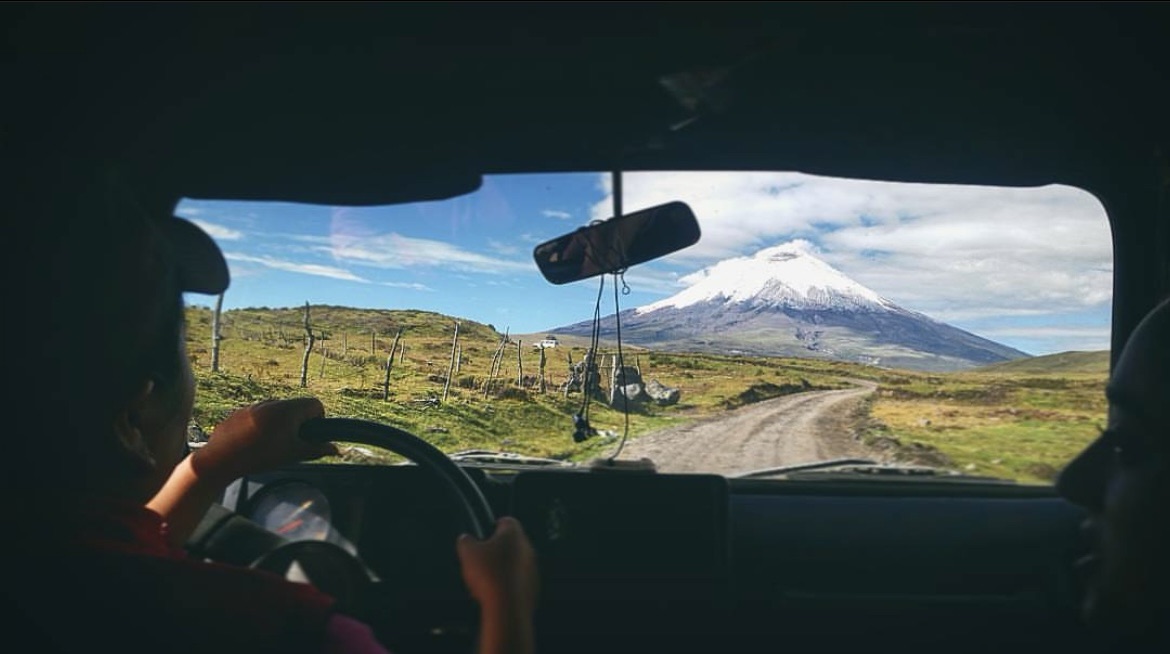
The Oaxacan sun is already peaking when our small group of Fundación En Vía volunteers and employees pile into the tour van at 9am. We are the pilot tour; a group consisting of a translator, two photo journalists, a prospective En Vía tour guide, the new tourism coordinator, and me, a communications and journalism intern. Although En Vía has been successfully running tours for 10 years, they, like the rest of the world, have had to push the pause button thanks to the pandemic. Our purpose here today is to test out new Covid safety protocols and to hopefully get the ball rolling for many more tours to come.
As the tour van bumps along the winding dirt road towards the small community of San Marcos Tlapazola, and as the Sierra Madre del Sur mountain range rolls along beside us, our tourism coordinator reads off the itinerary for the day. She places emphasis on the importance of the new COVID-19 protocols for these communities that were hit so hard in the past months.

This is the first coordinated tour with En Vía since December 2020 when COVID-19 made its daunting sweep through Oaxaca and the tours came to a screeching halt. In the absence of funds raised from these tours, En Vía has relied on the generosity of donors to keep up with its interest-free microloan program, which has been the backbone of the organization since the beginning. With interest rates in Mexico ranging from 70% to 200%, an organization that offers interest-free loans is almost unheard of for most indigenous artisans struggling to get their businesses off the ground. This was the case for Angelica, a local artisan specializing in embroidered aprons.

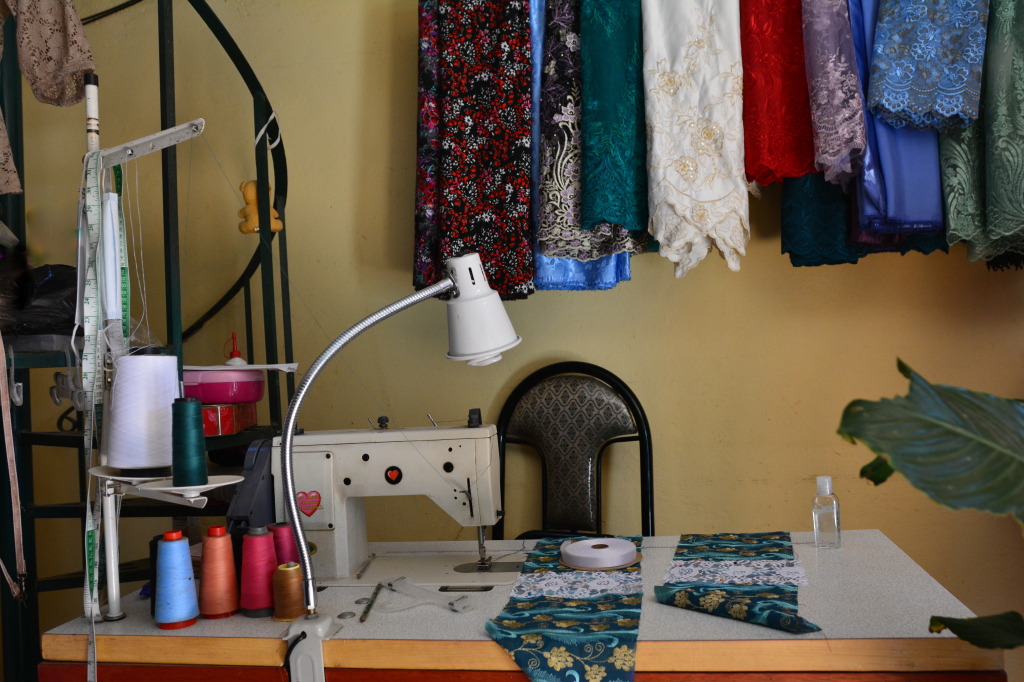
At 10am we find Angelica ready to welcome us behind the counter of her dress and apron shop with her hands confidently folded in front of her embroidered apron.
She tells us that she was introduced to En Vía by her sister-in-law, Marcelina, who convinced her after her own success story that the micro-loan program offered by En Vía was to be trusted. A year later, Angelica’s business is booming. She tells us that she uses her facebook business page as outreach for her commissioned work, drawing in loyal customers from all over the states.
After thanking Angelica for her time, we step outside her shop to gather around her sister-in-law, Marcelina.

Marcelina is standing proudly behind her table of assorted pottery and tostadas, wearing an embroidered apron made by Angelica. Her pottery is an assortment of tea kettles, mugs, vases, and mezcal shot glasses with faces molded from the clay. She describes to us the process of hiking to the mine to harvest clay she uses for her pottery. She says for each trip she hikes back with about four sacks of clay tied to her back. She says that although the clay itself is free, she has to pay people to help her harvest and hike the clay back. She admits that the pandemic has been hard on her business, but that she has found relief in the Growing Strong program provided by En Vía, a program that gives the women the option of either starting a vegetable garden or hosting chickens. Marcelina, like most of the women, chose the chickens which she says provides her with the options to either sell, butcher, or keep for the eggs. She says that she started off with 10 chickens and now has 35, and when asked where she keeps all of these chickens she answers, “Tengo en mi casa [sic],” (in my house).

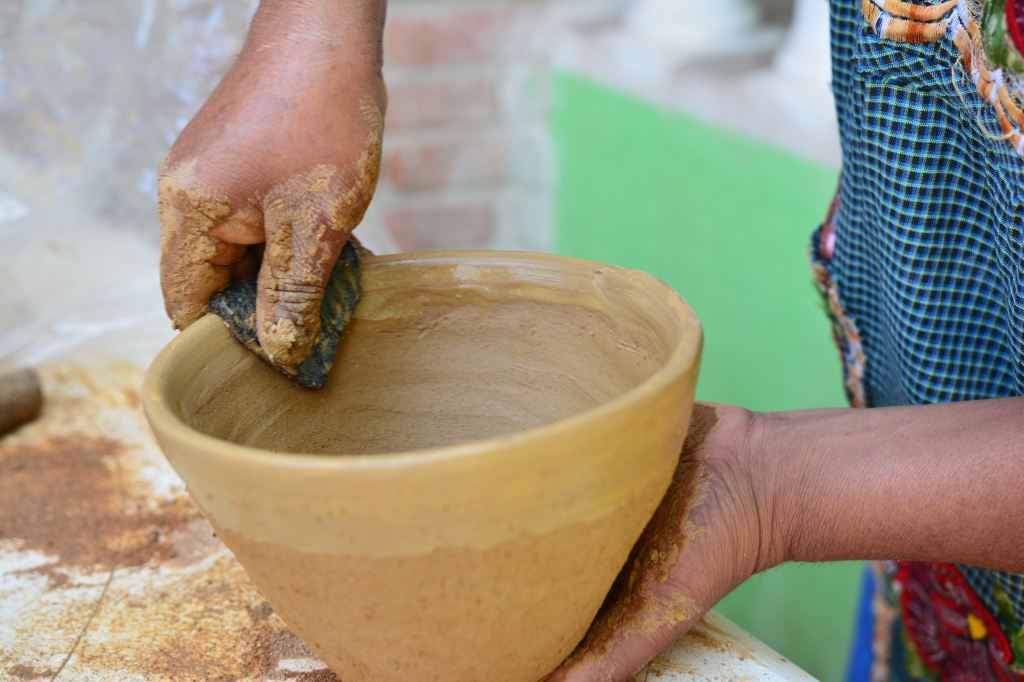
Angelina is the third artisan we visit of the day. In 2018, she joined En Via’s micro-loan program and has since put her loans entirely into her clay business. Her spacious studio is a sweet relief from the harsh midday sun. She says she has come a long way since she was a teenager and would help her parents with their clay business, carrying the pottery in a basket into Oaxaca city center and using the money she got from her sales to buy groceries and carry them back to her family in the same basket. She leads us outside and gives us a thorough demonstration on how she makes her pottery by hand, using a unique assortment of tools in replacement of a wheel. Angelina’s pottery tools include dried corn cob, a piece of wet leather, and the skin of a jicara fruit.”

After we break for a delicious lunch of sweet chicken mole over yellow rice, grilled Oaxacan cheese, crispy enchiladas, and pickled vegetables, we visit the community of Teotitlán del Val, home of the weavers. We are warmly greeted by a group of three cousins, Minerva, Magdalena, and Leticia. On the floor they have laid out a neat row of yarn bundles, all different colors with bowls corresponding to each color. Inside each bowl are the various natural ingredients used for dying the yarn. Spanish moss is blended to create shades of forest green and beige, sweet acacia bark for blacks, and a type of scale insect that lives on prickly pear cacti called cochineal is used for the oranges and reds.

Minerva is the oldest of the three women and has been weaving since the ripe age of 12. She is the most advanced and specializes in the most intricate of patterns. She has just completed a large woven tapestry after three months of work with over 30 colorful birds flying around a geometric tree and vines crawling in and out of the branches. After completing a weaving demonstration, Minerva speaks of her passion for weaving and its significance to Teotitlán, but she also shares her concerns that this age old art form is dying out with the older generations. This is why, she explains, that her long term dream is to start a weaving school for the children of Teotitilán, and now, thanks to the micro-loan program and her growing business, she sees this dream as an achievable goal.
Magdalena, Minerva’s younger cousin, says she plans to use her loans to buy smaller looms so that her own children can already start learning how to weave. She says that it is common in the community for the children who aren’t yet tall enough to reach the looms to perform other tasks such as brushing and washing the wool. As soon as they are tall enough to reach the pedals of the loom, that’s when they begin learning how to weave.
She speaks of how before she was introduced to En Vía she worked for companies that required her to weave certain patterns with certain colors, stifling her creative process. Now that she has been able to build up her own business using the loans from En Vía, she says she is free to weave on her own creative terms.


As Minerva and Magdalena are busy answering the questions of our wide eyed pilot tour, I meander over to watch Leticia skillfully play her loom. The loom, which resembles a piano in its grandiosity, foot pedals, and many strings, is producing one of the most beautifully intricate patterns I have ever seen. Leticia explains that she is weaving a rug, and the patterns she has planned are based on grecas, an ancient Aztec pattern. She says that she forms these patterns through mathematical formulas that she has memorized, counting the rows of each color based on her chosen design. She says her goal is to become as skilled as Minerva so she can bring to life all of the intricate designs she has in her head.
At the end of the visit the women hand us each small cardboard cutouts, which I realize soon after are their business cards neatly handwritten with their name, type of business, phone number, and if they have it, their email. After shopping around their store, we thank the women for their time and head back to the tour van, satisfied by Oaxacan cuisine, cultural education, and handmade trinkets gathered from each stop.
It is 3:30, and our pilot tour has come to an end. Our little group is exhausted from the heat of the day, but more than that, we are inspired by the talented artists we have met today and excited for all the tours to come.

A huge shout out to Payton Haynes for his natural talent with a camera. To follow his work check out his photography page on Instagram @payrayhay
 See gressa grow
Leave a comment