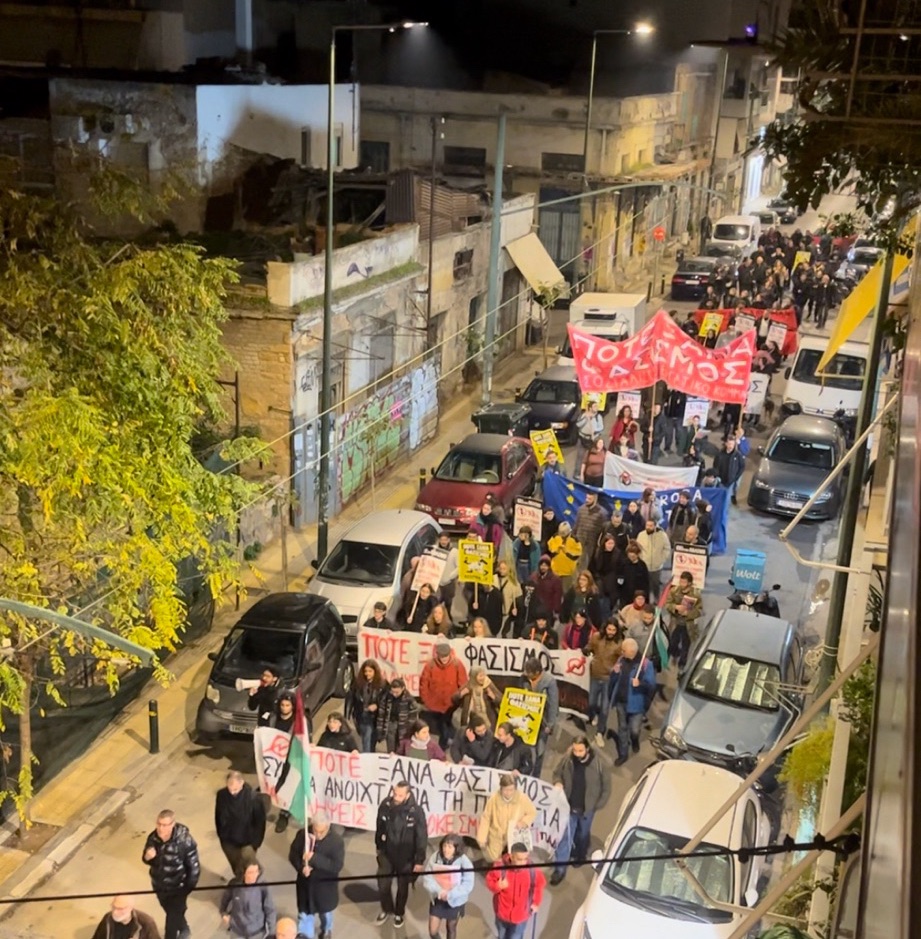
I found myself, one late night in February, in Exarchia, the edgy anarchist neighborhood of Athens, buried in a one-sided conversation with a tipsy film director. He said he was living in Berlin, although his ponytail and parachute pants said that for him. We’d both found ourselves getting some fresh air at a Palestinian refugee fundraising event, sitting side by side around an iron fire pit bowl.
The conversation was going great for a while; I was spitballing every film and theory that popped into my head, doing my best to sound competent, and he seemed genuinely excited to discuss his life’s passion with his new pupil. It was all going great, that is, until the Berlin-based director asked me why I loved film studies so much. It occurred to me that the director had assumed I was a film student, and now I was in way too deep to correct him.
As luck would have it, I was fresh from completing a midterm research paper in which I’d picked apart and scrutinized the male gaze. So, feeling confident for the first time in the conversation, I responded that it was because I wanted to be the one to control the narrative for a change. Because I’m so sick of watching films knowing that most of them are written, directed, and produced by a mob of rich white men with a capitalist agenda. Because the big mirror of society (that is media and film) has been reflecting the experience of only a fraction of the human experience back at us for too long.
I went on and on like this, basically reciting my research paper, backing my claims with evidence, covering everything from Hollywood to Bollywood, and pinning it all on the male gaze.
The film director, who was a man but not a white man, leaned in as if to really take me in for the first time.“Yes,” he said after a long pause, “and by white women too.”
He took another moment to look at the ground, partially blocked by his billowing parachute pants, and then, looking back at me with a furrowed brow, said, “I understand where you’re coming from, and you’re right- the voices of white men do saturate film, but I have to say I don’t like the way you use that word control…” he furrowed his brow a bit more, “…yeah that’s just not sitting right with me.”
I sat there blinking, taken back by his frankness. “Yeah,” he pressed on taking a swig of his beer and leaning back in his chair, “I just really don’t like that word, control.” He annunciated the c and the t and spat it out like it tasted bad.
I must have been looking down at my drink like I wanted to disappear into it, because when the film director looked up, he forced a chuckle and stammered, “I’m sorry, aha, I’m drunk.” And without any warning, he clumsily stood up from his chair and raised his beer at me in a final gesture. I watched him wander around for a while, hovering with his beer in hand behind a few social circles like a bee deciding on a flower before committing to a group of fellow parachute-panted hipsters. I sat there for a while, contemplating his words and staring into the fire. Control…control…
Oh my God, am I controlling?
I do like to be in control of things. I can’t stand when people are in control of a thing when I know that they’re wrong, specifically when I know that their narrative is dripping in a poisonous, capitalistic, patriarchal, misogynistic, racist, and homophobic scheme. Even if they aren’t aware of it themselves. After simmering on our conversation for months, it occurred to me that even the urge to be in control is in itself patriarchal and capitalist. Do I really think I will make anything better by being in control of the narrative?
During my research I encountered many peer-reviewed articles written by white female scholars who raged about taking back control of the narrative. Taking back the power in order to regain balance and equity. But what if letting go of needing to control the narrative is actually a part of white women’s work to decolonize our minds? Do you know who controls? Colonizers control. Patriarchy controls. Capitalism controls. The Israeli regime controls Palestinian life. Abortion laws control women’s bodies. The creepy 9-5 hamster wheel amusement park ride that the entire working-class gets ushered onto, buckled into, and then left on with no way off, controls our bodies and our lives while we’re here on earth. Our preciously fleeting bodies and lives.
I don’t want to take any part in a system that controls. Maybe, I don’t need to take back control of the narrative to make a difference. What if my real power as a storyteller (and assumed film student) is the pure passion behind that desire to be in control? Maybe all I need to do is skillfully steer my ship and let the wind in the sails do the rest. What if I speak and then let the wind carry my voice only as far as it needs to go? As far as it needs to go and no further, letting other voices pick up where mine leaves off, reaching ears mine could never reach.
Maybe there is no need for control at all—only skillful steering and trust. Anyway, if you’re reading this, hipster parachute-panted Berlin-based film director, thanks for the food for thought. Also, not a film student, but maybe you figured that out already.


 See gressa grow
Leave a reply to seegressagrow Cancel reply